Retrieval
Recovering what is already present but has become inaccessible.
Retrieval means recovering what is already present but has become inaccessible through distraction, overwhelm, shame, trauma, urgency, habit, or algorithmic attention capture.
Retrieval is not self-improvement. It is recognition. It is the moment the nervous system receives enough evidence to remember a truth it could not access a minute before.
The sequence
Notice
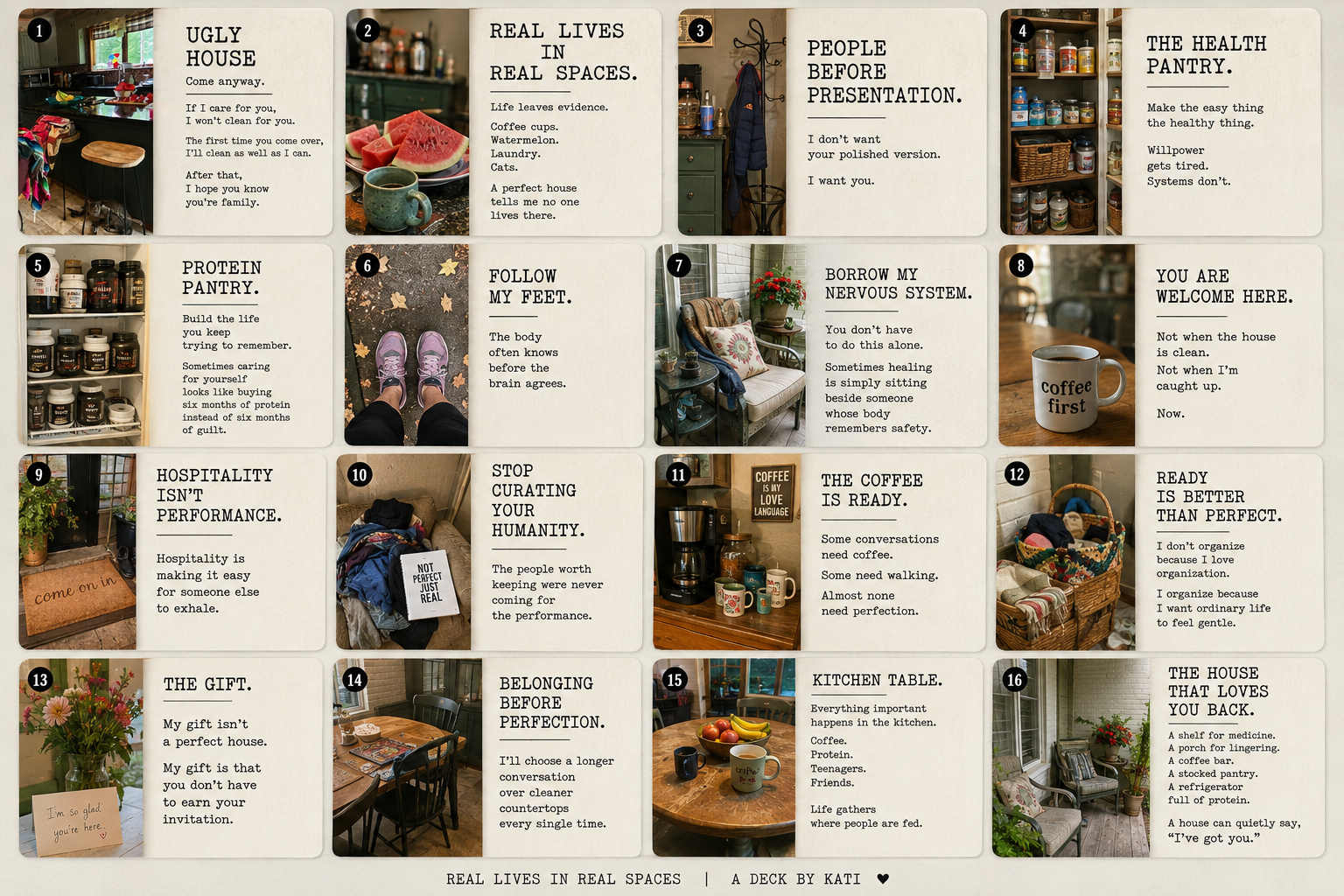
Something ordinary is present. A porch chair. A coffee cup. A cat paw. A stocked pantry. A sentence that lands.
Name
Give the moment accurate language. Ugly House. Ordinary Love. The Bed Is a Liar. Follow My Feet.
Retrieve
Allow that language to bring back a truth, movement, memory, humor, belonging, safety, or curiosity.
Metabolize
Encounter it repeatedly until the nervous system has digested it. Not as a lesson. As a lived cue.
What retrieval is not
- Not self-help
- Not curated advice
- Not an app
- Not hustle or optimization
- Not manifestation
- Not a lecture or a demand
- Not a substitute for real life
What retrieval is
- A finite tactile ritual
- A portable environment
- A small interaction that can compete with the phone
- A physical cue that returns attention
- Evidence, not instruction
- Beauty as regulation, not decoration
Core beliefs
Ordinary life deserves extraordinary attention.
Beauty regulates the nervous system.
Evidence is more powerful than instruction.
Real lives happen in real spaces.
People belong before they perform.
Tiny rituals beat grand resolutions.
Love leaves evidence.
Curiosity is the altar to fear.
The interaction model
The phone loop
Reach, pick up, tiny anticipation, swipe, surprise, consume, continue.
The retrieval loop
Reach, pick up, shuffle, tiny anticipation, draw, recognize, set down, return to life.
Same pick up. Same spark. Different outcome.
Every object must answer one question:
Does this retrieve?
Or does it merely impress?